Backend & APIs
CoreWhere most of my work lives.
- Node.js
- Python
- Express
- NestJS
- FastAPI
- REST
- MongoDB
- MySQL
Software Engineer
And then I make sure they keep working.
Event-driven backends, queues and pipelines — the parts that decide whether a product survives its own traffic.
I move fast. I also care about getting it right.

2.3 yrs
building and running systems in production
1000+
videos a month through the pipeline I own
Writing code was never the job.
Engineering was always about solving the problem with the best tools your domain hands you. One of those tools now writes code. So I use it every day — to read more logs than I could, to draft three designs instead of defending my first idea, to try every path through a piece of test data. What it doesn't do is decide which number matters, or notice that the number everyone quotes has no source, or own it at 2am. That part is still the job.

Education
Pilani campus. Years of being surrounded by people who were better than me at something, which turned out to be the useful part.
About
I build AI products end to end — pipeline, backend, frontend, and keeping them running once they are live. Outside work I build tech for the everyday problems I notice around me. Learning by doing is what keeps making me better at the part that matters: working out what the real problem is.
Off the clock
Guitar and singing. Filmmaking. Football — playing, not watching.
Skills
Grouped by what I actually reach for. The three marked core are where most of my time goes.
Where most of my work lives.
Kafka, SQS, FIFO ordering, idempotency, retries, dead-letter queues.
Shipped in real workflows, not demos — and the same tools run my own day. I measure whether they actually earn their cost.
Deploying it, running it, and being the one paged for it.
Enough to own a product end to end.
The one I care about most. A system you can't see into is a system you're guessing about — and every number on this page came from having built the thing that reports it.
The creative side I never dropped.
The list is the easy part. Picking one, and knowing why not the other, is the hard part — which is what the next section is actually about.
How I work
In this order. The tools change constantly; the sequence hasn't.
A ticket tells you what someone typed. I go find out what they were trying to do — which is often a different problem with a different answer.
If a failure can only be described as “it broke”, it was never broken down. Each piece should be able to fail on its own, visibly.
The empty field. The message that arrives twice. The one dealer who uploads a hundred cars at once. These decide whether it survives.
Pick the architecture, write down what it was chosen over, ship it, and measure it. Every number I claim comes with how I measured it.
Recent work
Four from work, one from my own time. Open any one: what was asked, what it turned out to be, how I built it, and what changed. Written for someone who has never seen these systems — no jargon, and where a word is unavoidable I explain it.
Projects
Nobody asked for any of these. Each one started with something I wanted to understand, so the interesting part is usually one decision rather than the whole thing — that's the line marked ◆ on each card.

Agentic trip planner
Say where you're going and for how long, and you get a day-by-day plan back. An agent pulls what it needs as it needs it — places, stays, current prices — and then a separate critic reads the finished plan with fresh eyes before you ever see it.
The critic loop stops after three attempts. Without a ceiling, a critic that keeps rejecting and a planner that keeps rewriting will happily burn tokens all night.
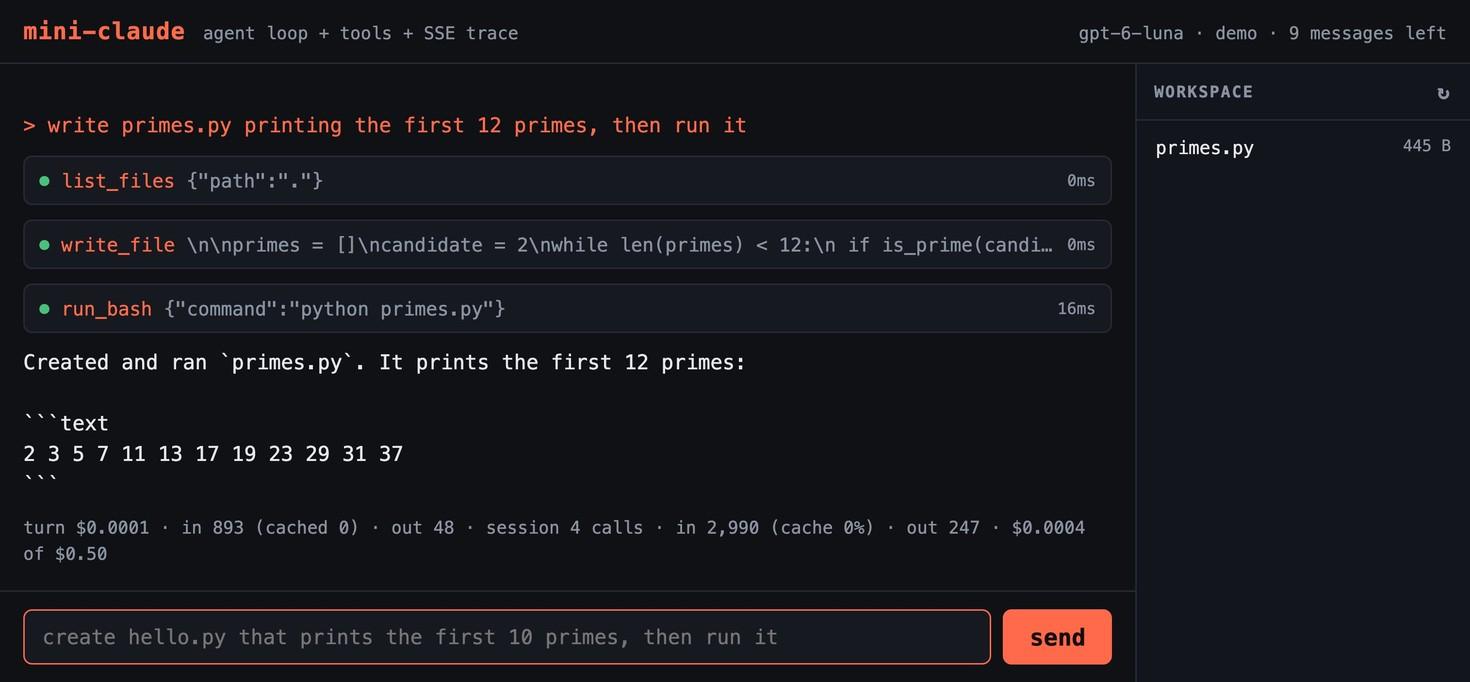
A coding agent, built from scratch
A small version of the AI coding assistants everyone now has open all day, built to find out how they actually work. Give it a task and it reads files, writes them, and runs commands until it's done. The page shows every step live — what it's weighing up, which tool it reached for, what came back, and what the turn cost.
It's public, so the shell it runs commands in works off a list of what's allowed rather than a list of what's banned. A list of dangerous commands is one you are permanently one entry short on.
Smaller experiments — a 3D haunted house, a shirt you can spin and redesign, a Kafka implementation, a realtime drawing board — live on GitHub without a write-up. All of them are there.
Contact
Happy to talk about engineering, business problems, music, or football. If you're hiring: I want to own something real, with users and a number attached to it.
I'll happily argue the other side of anything on this page. Most of what I know came from being wrong out loud.